Ships in 1-50 MWp size. Dividable into 100 kWp Modules.
Even the outer islands of remote archipelagos can have similar low electricity production costs as the main island hubs.

ELEMENTS OF HORIZON
Even the outer islands of remote archipelagos can have similar low electricity production costs as the main island hubs.
Integrated in the floating Reverlast Module or BESS on the beach. Both options available.
Module length: 100m
width: 5m
weight: 30tn kg
By up to 10cm thick glass fiber walls.
More complex anchoring possible upon request.
Remote island and coastal grids run on diesel. Not because renewables don't work - but because they haven't been designed for places where land is scarce, in competing use, or constrained by terrain, and where infrastructure is limited.
Floating solar on lakes and reservoirs is already a proven technology. Moving it to coastal and marine waters is not. Wave loads, salt corrosion, biofouling, and mooring complexity multiply.
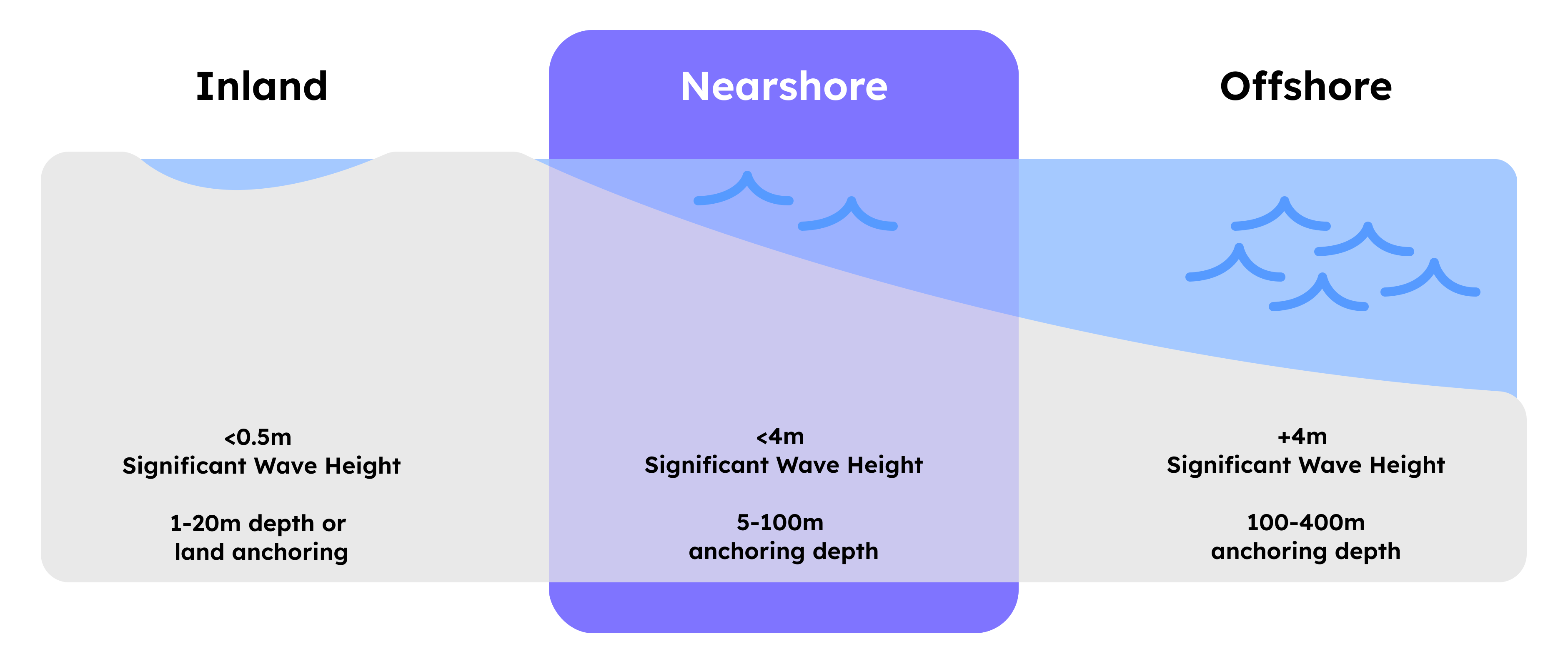
Reverlast is designed specifically for this environment - withstanding significant wave heights up to 4 m, water depths up to 50 m, and deployable 0.5 to 15 kilometers from shore.

Reverlast system scales from 1 to 50 MWp and is built from standardized ~100 kWp modules, allowing phased deployment and adaptation to local conditions. A standard 1 MW configuration consists of 12 modules (approx. 120m × 100m footprint).
Spacing between modules enables maintenance crews to access any module by boat, while ensuring light passes through to sustain marine life and creating favorable conditions bio habitats. At the same time, partial shading can help moderate light and temperature exposure in sensitive coral reef environments.

As standard, every Reverlast module includes integrated battery storage (BESS, 1:3 MWp to MWh), deployed either inside the module or onshore. The system is designed as a dispatchable power plant, not an intermittent solar installation, with pure PV only available on request.
Energy generated during the day is stored and delivered to evening and nighttime demand. This enables replacing the expensive diesel hours around the clock, with the diesel genset remaining a key backup for extended weather event periods and emergencies.
THE STRUCTURAL ADVANTAGE
Every other floating structure company builds custom floaters from scratch. We start with a structural composite that the wind industry already spent billions engineering and hundreds of thousands to build.

Epoxy glass-fiber composite, originally designed to endure 25+ years of fatigue loads, ice, salt spray, and UV exposure at the top of a wind turbine. Lightweight, corrosion-resistant, and structurally overbuilt for floating solar from day one.

Around 50,000 blades are projected to to retire by 2035 and wind farm operators paying the bill for disposal services. With the continuingly fast wind turbine capacity additions, there's no shortage of blade material supply in the foreseeable decades.

Wind turbine blades are hollow structural shells with up to 10 cm thick walls. That interior becomes a protected bay for inverters, battery cells, and cabling. Electronics stay dry and shielded from the marine environment.
DEPLOYMENT
Our operations model is designed around geographical flexibility and minimal blade processing. We move to the blades, not the other way around. No stationary factories. Zero receiving port infrastructure requirements.
Retired blades are collected from wind farm decommissioning sites and transported to the nearest suitable port. A mobile prefabrication team converts blades into sealed pontoons, ready for outfitting.
Pontoons are loaded onto multi-purpose project cargo vessels with onboard cranes. Solar panels, inverters, BESS units, and mooring hardware travel with the pontoons. No specialized ships required.
At the project site, pontoons are lowered directly into the water from the vessel. Solar panels and electrical systems are connected on the water. The module is assembled into its final array configuration.
The completed array is towed to its mooring position, anchored to the seabed, and connected to the local grid via subsea cable. The entire process from site confirmation to first power takes approximately 5 to 6 months.